
In short
Zyuela's AI coach is useful because it shares a context with the rest of the app: it can draw on the user's journal entries and daily routines, which live in the same product. The model sits behind a Node.js server rather than in the app, so the key, the cost and the prompt stay under the product's control.
Reflection, coaching and habits usually live in three apps
Journalling in one place, a habit tracker in another, and coaching, if any, in a third. None of them knows what the others hold, so nothing can respond to what a person is actually working through.
The brief for Zyuela was one private space where the coaching has context, because the reflections and the routines are in the same product.
The value is the shared context, not any single screen
Home, journal, coach, tasks and profile are the whole product. Each is small on its own. Together they let guidance be about this week rather than about wellbeing in general.
- Guided journalling with entries tagged by mood, energy and topic, tracking an emotional baseline over time
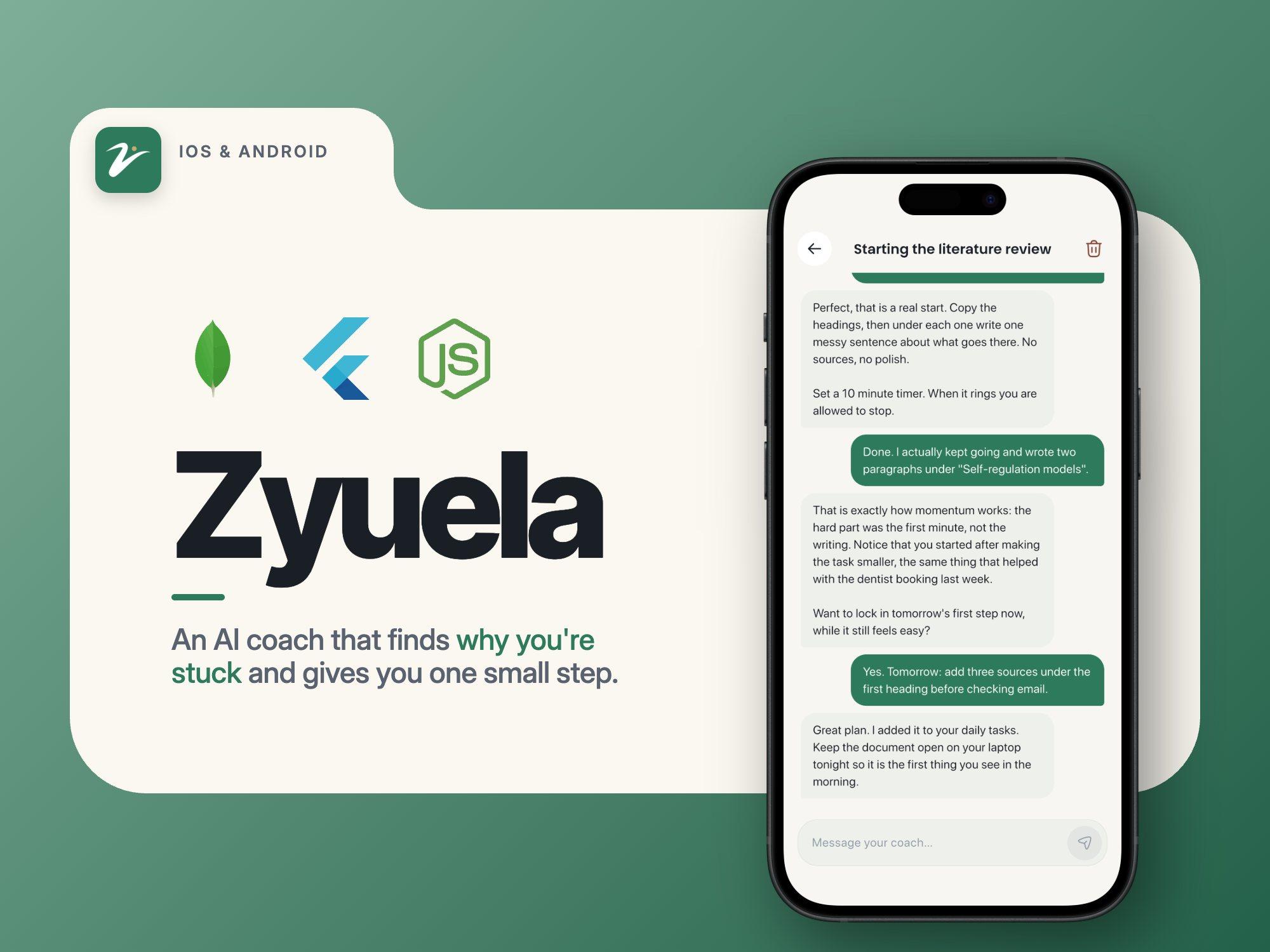
- An AI coach you can talk to, with sessions that each get a title and a short summary
- Daily tasks scoped to small routines rather than large goals
- A memory screen with a written summary of the user's patterns and the habits detected so far
The memory screen is the visible half of the idea: the user can read what the coach has picked up, rather than wondering what it remembers.
Keep the model behind your server, not in the app
Zyuela's Node.js and MongoDB backend owns authentication, persistence and every call out to the AI APIs. The Flutter app never talks to a model directly.
That is what makes the API key, the cost and the prompt things the product controls. A key shipped inside an app can be extracted; a prompt in the client can be changed only by releasing a new version; and spend is impossible to cap per user if the server never sees the call.
The model is a component with a job, not the product.
Designing for the user who comes back after a gap
Progress in Zyuela is presented as insight into change over time, not as a score that resets. Returning after a week away costs nothing, which is the behaviour the whole design aims at: a streak you are afraid to break is a reason to stop opening the app.
On the Flutter side, Clean Architecture with BLoC and Cubit keeps the coach as one feature among several rather than an assumption baked through the app. Any surface added later inherits the shared context for free.
Questions
Does the Zyuela app call the AI model directly?
No. Every AI call goes through Zyuela's Node.js backend, which also handles authentication and storage.
Why combine journalling, habits and coaching in one app?
So the coach can respond to what the person is actually working through, using the reflections and routines that live in the same product.
Does Zyuela punish missed days?
No. Progress is shown as change over time rather than a streak that resets, so coming back after a gap costs nothing.